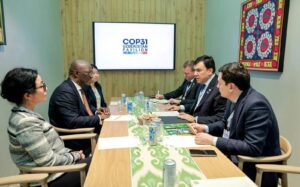
Prime Minister Olzhas Bektenov met with Amina Lahreche, Chief of the International Monetary Fund‘s mission to Kazakhstan, Qazinform News Agency learned from the Government press service.
During Monday’s talks, the two sides reviewed the mission’s findings and discussed the next stages of Kazakhstan-IMF cooperation in the near and medium term.
The Kazakh premier briefed the IMF on institutional reforms carried out in the country. In July, the new Constitution took effect, laying the foundation for a Just and Strong Kazakhstan. Acting on President Kassym-Jomart Tokayev‘s directives, the Government continues its course toward a digital economy and shaping new points of economic growth.
Olzhas Bektenov highlighted the importance of expert dialogue with the IMF and of drawing on international best practices to improve the country’s economic policy.
“Our dialogue continues through regular missions, targeted consultations and the IMF’s technical assistance to government bodies. I hope the recommendations from this mission will serve as a useful reference point for further enhancing the country’s macroeconomic and macroprudential policy,” Prime Minister Bektenov emphasized.

Amina Lahreche presented the mission’s findings and gave a positive assessment of Kazakhstan’s macroeconomic situation.
She said the team arrived shortly after the President delivered his state-of-the-nation address and set out key priorities for infrastructure development and human capital investment. The mission chief said the IMF noted Kazakhstan’s significant economic potential and hoped the dialogue and recommendations would help ensure sustainable growth meeting citizens’ needs.
According to the IMF‘s October forecast, Kazakhstan’s economy will continue steady growth through the end of 2026 and accelerate next year. According to the fund’s information, Central Asian countries, including Kazakhstan, remain resilient to external factors thanks to reforms. Development priorities include price stability, coordination of monetary and fiscal policies, rebuilding fiscal reserves, and diversification of trade.
Over the first 10 months of 2026, GDP grew 4.5%, and fixed capital investment rose 4.9% to 18.3 trillion tenge. Industry and agriculture showed positive dynamics, with the highest growth rates in mechanical engineering (22.2%) and pharmaceuticals (50.9%). Agriculture was up 5.2%.
In closing the meeting, the Government reaffirmed its commitment to maintaining constructive dialogue and deepening win-win cooperation with the fund in promising areas. The relevant state bodies will review all IMF proposals and recommendations.
As written earlier, signs of economic overheating persist not only in Kazakhstan but also in other Central Asian countries and across the Caucasus, Roberto Cardarelli, Assistant Director of the IMF‘s Middle East and Central Asia Department, said at a presentation of the regional economic outlook.