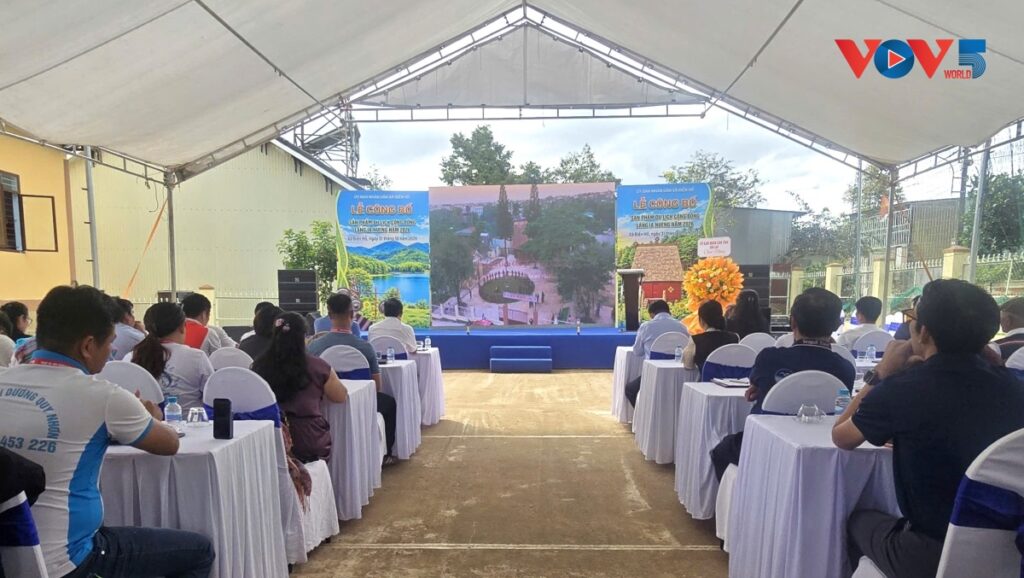
[VOVWORLD] – Ia Nueng village, located next to the Bien Ho national scenic site, is home to 200 households with 1,000 people, more than 96% of whom are ethnic Jrai who have preserved many of their traditional cultural practices. Ia Nueng has now begun developing community-based tourism to create livelihoods, boost local incomes, and help conserve the community’s culture.
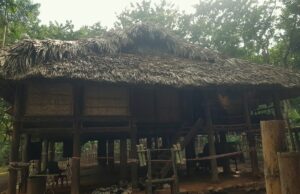
Ia Nueng village has 3 communal houses, 6 stilt houses, a cluster of centuries-old banyan trees, and a “water drop” – a mysterious water supply structure that draws clean water from an underground spring in the mountains. The village has preserved traditional crafts, including bamboo and rattan weaving, wood carving, brocade weaving, gong playing, and a distinctive cuisine.
Around these assets, Ia Nueng has designed a community-based tourism experience in which visitors can enjoy gong performances, join in a xoang dance, and try their hand at weaving and basketry.
Ms. Pel, head of the Ia Nueng Brocade Weaving Cooperative in Bien Ho commune, Gia Lai province, told VOV, “I hope more tourists will come to our village. We can prepare food and offer weaving materials for visitors to experience the craft and learn about brocade weaving.”
Visitors can also participate in farm activities like planting and harvesting rice, pounding rice, and cooking bamboo-tube rice. During the coffee harvest season, they can pick, roast, and grind coffee beans and enjoy freshly brewed coffee right at the plantation.
Tourists are invited to watch skillful Jrai women at their looms, weaving brocade fabrics with the distinctive colors of the Central Highlands, of Jrai artisans turning bamboo, reeds, and rattan into household items.
Local resident Ro Lan Han says community-based tourism gives villagers an opportunity to earn higher income and encourages them to preserve their traditional crafts.
“I hope the villagers will unite in developing community-based tourism. We should share our brocade-weaving skills with the younger generation so they will understand their cultural identity. Training young people to be tour guides will teach them the Jrai cultural traditions,” said Ro Lan Han.
Visitors to Ia Nueng can do more than take photos of the costumes and communal houses. They can step into the cultural space of the Jrai people, listen to them tell stories about their gongs, learn the meaning of their ceremonial poles, and experience the rhythm of community life.
The sound of gongs is deeply resonant and evocative. For Central Highlanders, gongs are the voice of their village, an echo of their ancestors, and a connection between people and nature.
Ahay, a member of the Ia Nueng village gong team, said, “I hope gongs will become known more widely. When tourists come here, they can learn about our gong culture and how the Jrai people perform the xoang dance.”
A handful of rice pounded by hand, a scrap of brocade cloth woven from colorful threads, a cup of coffee brewed with a Vietnamese-style filter…gives the visitor a direct experience of the work, customs, and culture of the Jrai community.
Cultural values that have always been part of their everyday life are viewed by the Jrai people as valuable assets. Chu Van Chi, the owner of the To Nung Homestay, said, “In the future, we plan to develop tours that give each visitor a unique experience as they explore the village and experience its culture, including brocade weaving and basketry.”
According to Dang Khanh Toan, Deputy Chairman of the Bien Ho People’s Committee, the commune will continue to improve its service, develop accommodations and food and handicraft products, connect with travel companies, and boost tourism promotion.
“Developing Ia Nueng as a community-based tourism village, we recognize that local residents are the key actors. They’re the ones who created the culture, who produce the agricultural products, handicrafts, and musical instruments, and who work with the authorities to provide community-based tourism to visitors. This will boost incomes, maintain security and social order in the village, and contribute to the development of Bien Ho,” Toan noted.
Ia Nueng is being positioned as part of a tourism network that links it with other attractions like Bien Ho Lake, a century-old pine road, tea hills, and the Chu Dang Ya volcano. Such combinations of scenic landscapes with cultural experiences diversify Gia Lai’s tourism products and make it a more attractive destination.