PH-Chile trade deal opens duty-free gateway to Latin America – DTI


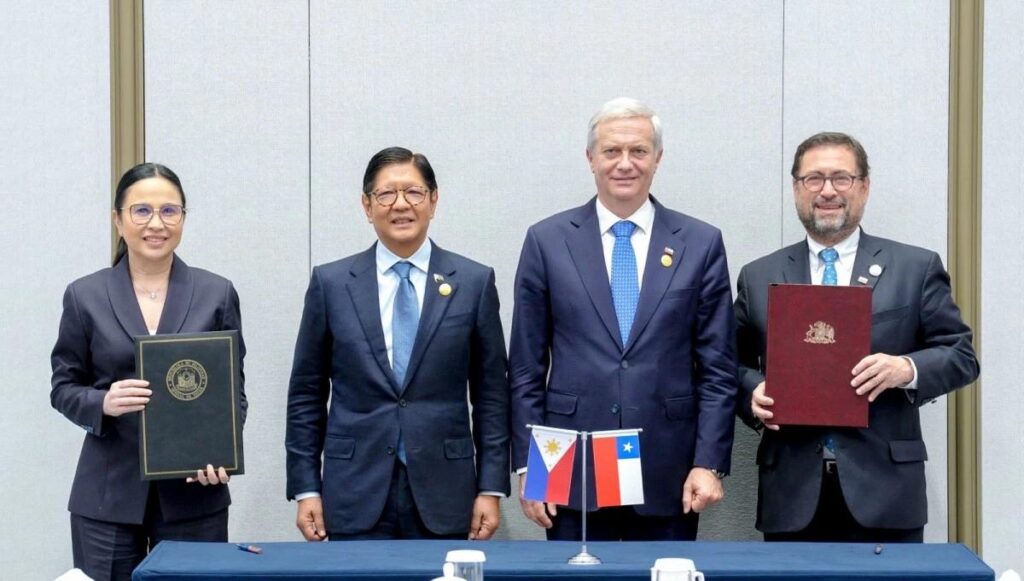
The Philippines and Chile have signed the Comprehensive Economic Partnership Agreement (CEPA), marking a historic milestone in bilateral relations and opening a new chapter of economic cooperation between Southeast Asia and Latin America.
As the Philippines’ first free trade agreement with a South American partner, the agreement expands opportunities for trade, investment, and economic collaboration between the two countries.
The signing of the PH-Chile CEPA strengthens the Philippines’ engagement with one of the world’s most dynamic regions and reinforces the country’s commitment to an open, rules-based, and inclusive trading system.
According to Department of Trade and Industry Secretary Cristina A. Roque, the agreement demonstrates the Philippines’ resolve to expand opportunities for Filipino businesses beyond traditional markets.
“The world is our market, and Filipino businesses are ready to compete. The PH-Chile CEPA opens new doors for our exporters, strengthens our manufacturing sector, and advances our goal of creating better jobs and greater opportunities every Filipino,” Secretary Roque said.
Chile is widely recognized as one of the world’s most outward-looking and globally connected economies, with one of the most extensive networks of free trade agreements anywhere in the world.
The country serves as an important gateway to South America, a market of more than 400 million people with significant growth potential. For the Philippines, the agreement opens new pathways to diversify export markets and deepen commercial engagement with Latin America.
The PH-Chile CEPA is expected to create new opportunities for Filipino businesses, consumers, and workers. It provides Philippine exporters with improved access to Chile’s market of nearly 20 million consumers while positioning Filipino enterprises to expand their presence across the broader South American region.
Among the agreement’s key benefits is enhanced market access for Philippine exports. Virtually all current Philippine exports to Chile will enjoy duty-free treatment, benefiting a wide range of export products, including electronics, machinery, desiccated coconut, carrageenan, processed tuna, and other value added agricultural and manufactured goods. These improvements are expected to strengthen the competitiveness of Philippine products and support the continued expansion of the country’s export sector.
The agreement will likewise help diversify sources of supply, strengthen supply chains, and improve access to critical industrial inputs. Access to products such as copper and other manufacturing inputs is expected to support the Philippines’ industrial development agenda, energy transition efforts, and growing digital infrastructure requirements.
The PH-Chile CEPA also highlights the importance of trade agreements in supporting industrial growth and job creation. By opening access to larger markets, Philippine manufacturers can expand production, attract new investments, achieve economies of scale, and become more globally competitive. Stronger exports, in turn, support employment across key sectors such as electronics, machinery, food processing, and other high-value manufacturing industries. These gains reflect the Philippines’ broader strategy of pursuing an ambitious and forward-looking trade agenda under the leadership of President Ferdinand R. Marcos Jr. By expanding market access and reducing trade barriers, the government aims to create more opportunities for Filipino enterprises to compete and grow internationally while attracting investments and generating quality jobs at home.
Beyond trade in goods, the PH-Chile CEPA is a modern and comprehensive agreement covering services, investment, digital trade, intellectual property, government procurement, and economic cooperation. It establishes a more predictable and transparent business environment that supports long-term resilience, competitiveness, and innovation.
The agreement opens new opportunities for Philippine service providers across sectors such as professional services, information and communications technology, education, tourism, logistics, and research and development. Filipino professionals and enterprises will have greater opportunities to establish commercial operations and participate more actively in Chile’s economy.
The PH-Chile CEPA also establishes modern rules for the digital economy, including provisions on digital trade, cross-border data flows, electronic transactions, consumer protection, and cybersecurity cooperation. These measures are expected to facilitate innovation, strengthen trust in digital transactions, and support the growth of the digital economy. Importantly, the benefits of the agreement are designed to be broadly shared.
The PH-Chile CEPA includes dedicated chapters on MSMEs, Global Value Chains, Environment, Labor, and Trade and Gender, recognizing that economic opportunities should extend to smaller enterprises, women entrepreneurs, workers, and communities. Through cooperation and capacity-building initiatives, the agreement seeks to ensure that more Filipinos can participate meaningfully in and benefit from international trade.
For MSMEs, the agreement offers greater access to information, technologies, business networks, and opportunities to participate in regional and global value chains. For women entrepreneurs, it provides stronger support for participation in trade, investment, innovation, and digital commerce, contributing to more inclusive and sustainable economic growth.
While the signing marks a major milestone, DTI emphasized that implementation will be key to realizing the agreement’s full benefits. The ultimate measure of success will be the agreement’s ability to translate commitments into stronger exports, more competitive industries, increased investments, greater innovation, and better-paying jobs for Filipinos.
The PH-Chile CEPA ultimately serves as a bridge between Southeast Asia and Latin America, connecting businesses, creating opportunities for people, and laying the foundation for a stronger and more enduring partnership between the Philippines and Chile in the years ahead.