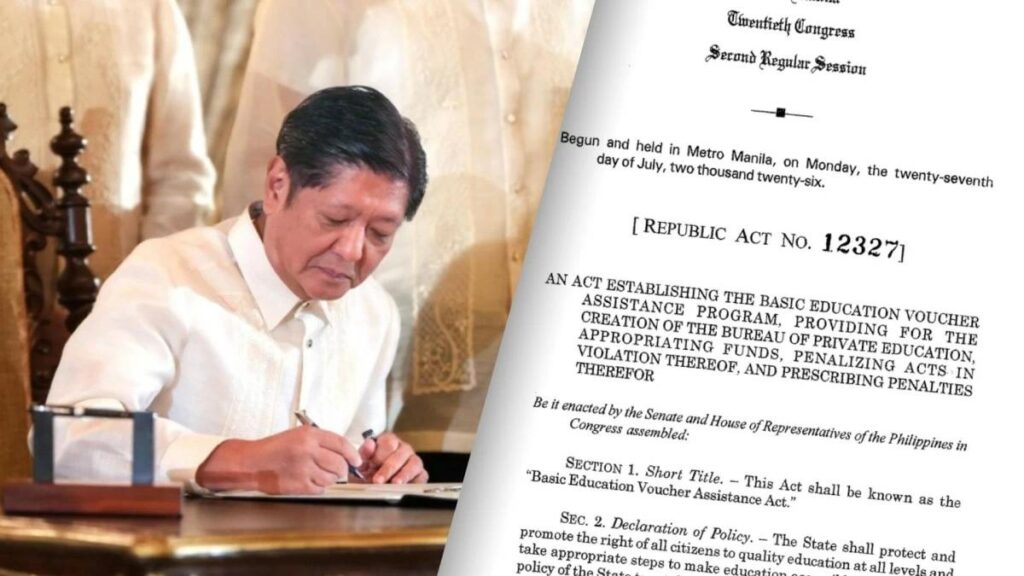
President Marcos has signed a law institutionalizing the government’s Basic Education Voucher Assistance Program, expanding financial support for qualified students in private schools while addressing classroom congestion in the public education system.
Republic Act No. 12327, or the Basic Education Voucher Assistance Act, approved by the President on Nov. 12, establishes a government-funded assistance program for students enrolled in participating private basic education institutions.
Under the law, eligible students will receive government vouchers to help cover school fees, while participating private schools may also receive subsidies for teachers and other forms of assistance.
The program will cover Filipino citizens belonging to middle-middle-income households and below, or those under equivalent income classifications, with priority given to students from poor and low-income families.
Students may qualify based on several criteria, including enrollment in public schools identified by the DepEd as congested, residence in areas without nearby public schools or schools offering appropriate subjects, and residence in communities served by overcrowded public schools.
The amount of assistance will be determined by the DepEd based on commissioned research and reviewed at least every three years to account for inflation and other factors, but it cannot be lower than the assistance currently provided by the department.
The law also provides that students from poor and low-income households may receive higher voucher amounts, while the program’s budget will be distributed equitably across all regions, including the Bangsamoro Autonomous Region in Muslim Mindanao, based on school congestion, available capacity, and open seats.
Qualified beneficiaries will be allowed to choose their preferred participating private school from a government registry, provided it is within a walkable distance of three kilometers from their residence or is the next nearest private school.
To strengthen oversight of private education institutions, the measure establishes the Bureau of Private Education under the DepEd as the agency responsible for regulation, quality assurance, policy formulation, and development support for private basic education institutions.
The bureau will also oversee minimum quality standards, monitor school performance and learning outcomes, and coordinate government assistance for private education providers.
The law requires the DepEd to establish anti-fraud safeguards, including a centralized verification system for learner eligibility, enhanced audits and inspections, and whistleblower protection mechanisms.
It also imposes administrative and legal sanctions, including suspension, disqualification, reimbursement of funds, blacklisting, and prosecution of schools or individuals found responsible for fraud or other prohibited acts.
Participating private schools are likewise prohibited from denying or restricting students’ enrollment, attendance, examinations, academic credits, or access to school records because of delayed, partial, or non-reimbursement of government voucher payments, subject to the conditions provided under the law.
The initial implementation of the measure at the kindergarten and elementary levels will begin in School Year 2027-2028, while current beneficiaries of the Educational Service Contracting Scheme and Senior High School Voucher Program will continue to receive assistance until they complete their basic education.
The law’s implementing rules and regulations must be formulated by the DepEd, in consultation with the Department of Economy, Planning, and Development, the Department of Budget and Management, and other concerned stakeholders, within 60 days from its effectivity, which is 15 days after publication in the Official Gazette or a newspaper of general circulation.