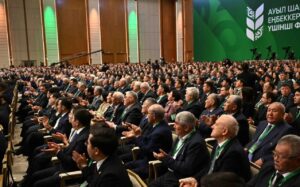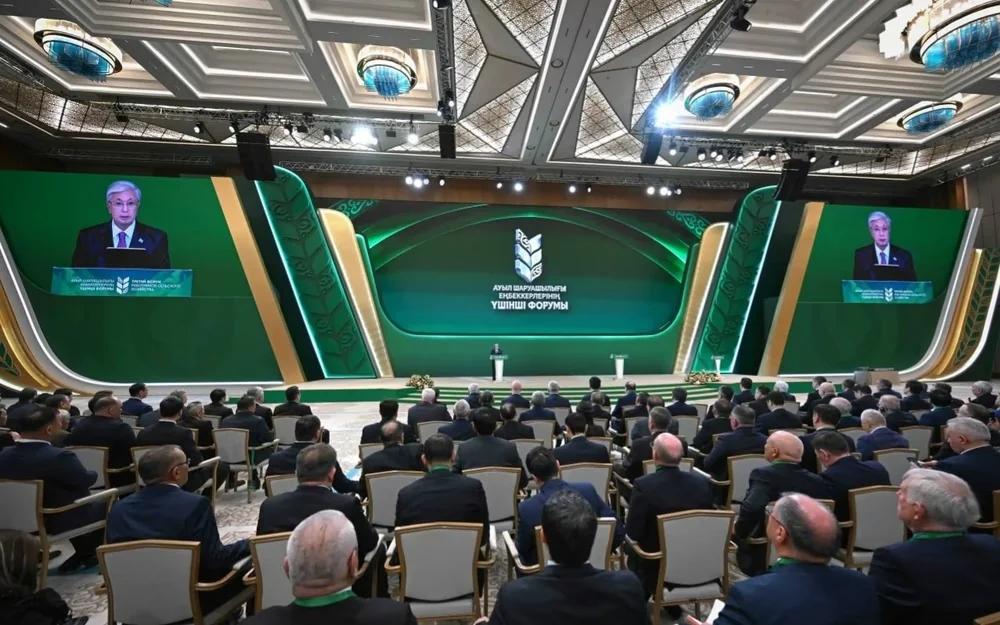
Addressing the III Forum of Agricultural Workers, Kazakh President Kassym-Jomart Tokayev assigned to raise the area of irrigated lands applying water saving technologies up to 1.3 million hectares by 2030, Qazinform News Agency reports.
The Head of State stressed that improving the efficiency of irrigated agriculture is a critically important issue. Currently, water-saving technologies are used on 700,000 hectares of irrigated land, accounting for less than half of the total irrigated area.
He said by 2030, the acreage must be increased to 1.3 million hectares. The Government is instructed to make this issue part of its continuous, day-to-day work, given its particular importance and relevance.
According to Kassym-Jomart Tokayev, reconstruction and repair work has begun on 4,600 kilometers of irrigation canals. Nearly 1,000 kilometers are expected to be commissioned by the end of this year, improving water supply for 200,000 hectares of irrigated farmland.
The Government, together with regional administrations, has been tasked with aligning irrigation expansion plans with water availability, the condition of irrigation canals, and the capacity of power grids.
“To fully realize the potential of crop production, all our efforts must be directed toward introducing advanced scientific approaches and modern technologies. As we know, the land does not forgive mistakes, but it generously rewards those who treat it with care and responsibility. You, more than anyone else, understand this well,” the President emphasized.
Kassym-Jomart Tokayev also stressed the need to increase productivity in crop farming, raise crop yields, and reduce production costs. He particularly stressed the importance of developing domestic fertilizer production, noting that the current situation, in which nearly half of the fertilizers used in Kazakhstan are imported, is unacceptable.
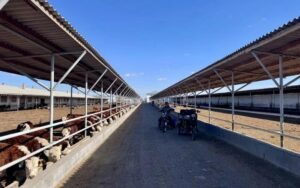
Earlier, President Kassym-Jomart Tokayev stated the need to create favorable conditions for the operation of livestock farms and modernise Kazakhstan’s veterinary system.