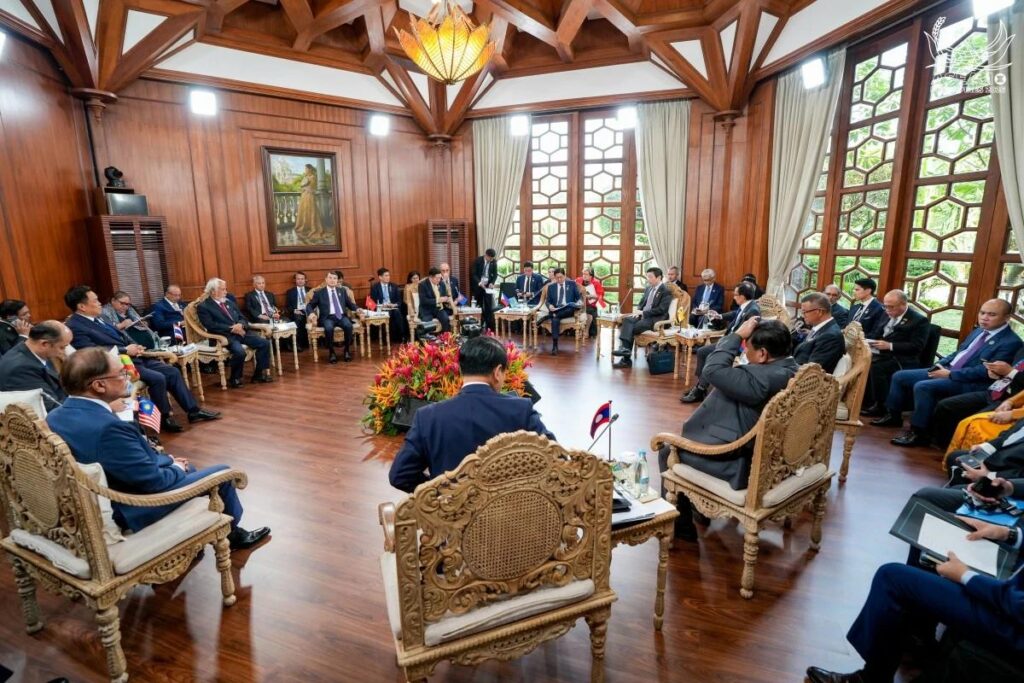
In a press conference at the International Media Center for the 49th ASEAN Summit on Sunday, Nov. 15, Lazaro disclosed that leaders reached the agreement during the ASEAN Summit Retreat held at the Coconut Palace in Pasay City.
“The step-by-step approach is adherence to the five-point consensus. So for example, the first one is cessation of hostilities: We want to see how Myanmar responds to that because right now there’s still certain bombings and displacement of Myanmar people,” Lazaro said.
“So, step-by-step. We give it to them how they’re going to tackle this issue. And we monitor that and for us that is what we have to say a progress-based approach,” Lazaro explained.
‘What more can we do’
In his candid engagement with fellow leaders during the ASEAN Retreat, Marcos urged them to reflect on what more they could do to help alleviate the situation in the country.
The President stressed that the crisis in Myanmar affects families and communities whose futures have been disrupted. Thus, the need to step up efforts to ease the situation in Myanmar.
“This is why our resolve is not simply to manage one crisis after another. It is to build an ASEAN that is more resilient, more responsive, and prepared, and better able to collectively take action,” Marcos said in his opening statement during the retreat.
“Five years since, we need to ask ourselves: What more can we do for Myanmar?” Marcos added.
“Ultimately, the crisis in Myanmar is about people, families who have been displaced, communities that need humanitarian assistance, and young people whose future has been interrupted by conflict and instability,” he further stressed.
The President underscored that Myanmar is not merely an issue on ASEAN’s agenda, but a part of the ASEAN family.
He hoped that their engagements would lead to practical and forward-looking discussions on how they could further advance the implementation of the Five-Point Consensus, make their efforts more responsive to the realities on the ground and support a peaceful, inclusive, Myanmar-owned and Myanmar-led process.