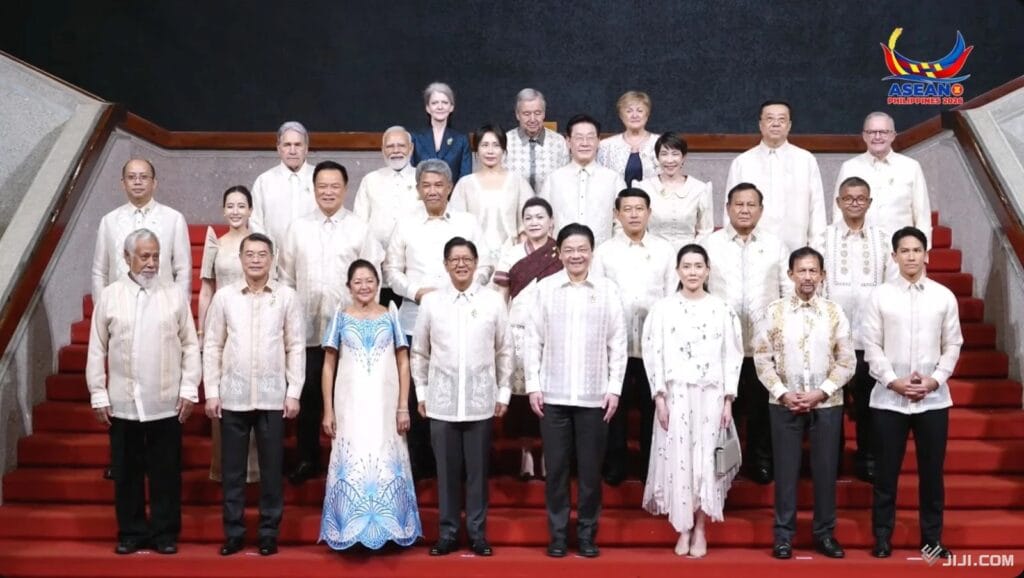
MANILA – President Ferdinand R. Marcos Jr. on Monday highlighted the importance of trust, shared interests and a sense of community in keeping the Association of Southeast Asian Nations (ASEAN) strong, saying the region’s unity has been built through generations of leaders who chose cooperation over division.
Addressing Southeast Asian leaders, dialogue partners, and their spouses at the ASEAN Summit Gala Dinner, Marcos said diplomacy may bring countries together at negotiating tables, but it is the relationships formed over time that sustain cooperation, especially when differences arise.
“Our work is sustained by more than agendas or documents; it is sustained by relationships, by the familiarity that allows us to speak candidly, the patience to listen when we disagree, and the trust that brings us back to the conversation,” he said.
Marcos hosted the gala dinner with First Lady Liza Marcos, welcoming ASEAN leaders and dialogue partners for an evening of Filipino food, music and hospitality on the sidelines of the 49th ASEAN Summit and Related Meetings at the Philippine International Convention Center in Pasay City.
Drawing on the Filipino concept of kapwa, which he described as recognizing a shared identity and common humanity, Marcos said the idea also reflected ASEAN’s spirit.
The bloc’s member states may have different histories, interests and aspirations, he explained, but have learned that their futures are interconnected.
“The peace of our neighbors strengthens our own peace. That prosperity shared across borders creates opportunity at home. And that when one part of our region is tested, the effects rarely stop at the national boundary,” Marcos said.
He traced this regional spirit to the foundations of ASEAN, recalling the 1976 Bali Summit, where his father, then President Ferdinand E. Marcos Sr., joined four other regional leaders at that time in concluding the Treaty of Amity and Cooperation in Southeast Asia, which established principles for regional relations and cooperation, helping lay the groundwork for regular dialogue and economic connectivity.
The President said these practices were not inevitable but were built through successive generations of leaders who chose to treat their countries’ futures as connected.
He also recognized the contribution of ASEAN’s external partners, saying the bloc’s direction must remain shaped by its member states, while its capacity has been strengthened by partners that have invested in regional peace, prosperity, resilience and people.
“At its best, partnership recognizes that our futures are intertwined, that one country’s strength can answer another’s need, and that each of us has something to contribute in return,” he said. (PNA)