
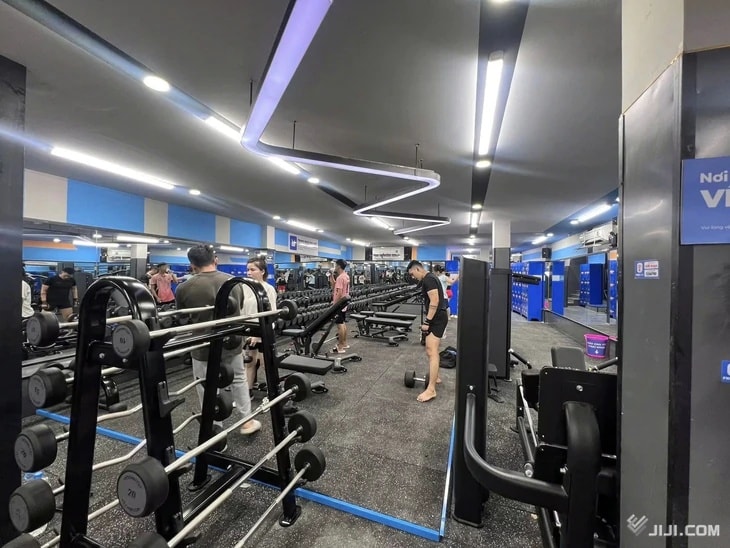
While several long-established gym chains are scaling back operations, budget fitness centers are seeking growth opportunities through affordable fees, flexible services, and leaner business models in Vietnam.
Following controversies surrounding gym closures and disruptions to membership benefits, consumers are becoming increasingly cautious about paying upfront for long-term membership packages.
At the same time, gyms charging just a few hundred thousand dong (VND100,000 = US$3.9) per month are putting competitive pressure on larger operators.
Major chains struggle with operating costs
Once known for sprawling facilities covering thousands of square meters and offering a wide range of amenities, several long-established fitness brands are now having to shrink their networks.
Most recently, California Fitness & Yoga suspended operations at its Binh Duong location on Sunday, following several rounds of closures in Ho Chi Minh City and other localities.
Citigym have also closed its branch at Van Hanh Mall and ceased operations at its Le Van Viet and Quang Trung clubs in the city.
In a notice to members, Citigym said it was facing operational challenges. Following a review, the company decided to downsize its network to focus resources, consolidate operations, and continue running six clubs.
The contraction of some gym chains does not necessarily mean demand for fitness services is declining.
According to Ken Research, Vietnam’s fitness services market revenue grew nearly 30 percent in 2023 before slowing to 12.3 percent in 2025, reaching approximately US$492 million.
Personal training (PT), premium memberships, and specialized fitness programs have been among the drivers of recovery, indicating that demand remains strong, although not all businesses have been able to capitalize on the growth.
The business model of selling long-term membership packages presents additional challenges.
Advance payments provide companies with an early source of capital, but they also create an obligation to deliver services over several years.
If new revenue streams weaken, operators must still maintain their facilities to serve existing members. When a gym closes, customers who have paid upfront risk losing access to services they have not yet used.
The market’s growing divergence also reflects changing fitness preferences. Rather than paying for packages that bundle numerous amenities, some customers prioritize gyms close to home, affordable fees, and flexible opening hours.
Size and facilities are therefore no longer the only sources of competitive advantage.
Budget gyms seek an edge through leaner operations
In contrast to the contraction of some established brands, budget gym chains are seeking expansion opportunities by focusing on equipment and workout spaces instead of spreading investment across a wide range of premium amenities.
In Ho Chi Minh City, Ways Station has developed a network of dozens of fitness locations, charging around VND320,000 (US$12.3) per month and allowing members to access multiple branches.
Many facilities operate around the clock, catering to people with different workout schedules.
Similarly, The New Gym has expanded from 10 to 15 clubs over four years. It offers one-month memberships with automatic renewal starting at VND319,000 ($12.4), depending on the branch and registration conditions.
Unlike operators that invest heavily in amenities, budget gyms focus on basic workout needs, limit costly facilities, and make efficient use of space.
This approach helps reduce fixed-cost pressures and makes it easier to maintain affordable membership fees.
However, profitability still depends on attracting enough members and retaining them through regular renewals.
According to a freelance personal trainer, shorter-term membership packages also allow customers to reduce upfront payments and switch gyms more easily if the services fail to meet their expectations.
Conversely, operators must maintain service quality to encourage renewals instead of relying on revenue from long-term contracts.
“Following gym closures, refund policies, membership transfers to other locations and arrangements for unused membership periods have also become issues that require transparent disclosure,” the trainer said.
“These are not only matters of customer rights but also factors affecting trust in fitness businesses.”
Meanwhile, specialized studios offering yoga, pilates, boxing, and personal training are providing customers with additional options instead of requiring them to purchase comprehensive gym packages.
Thanh Ha – Ha Phuong / Tuoi Tre News