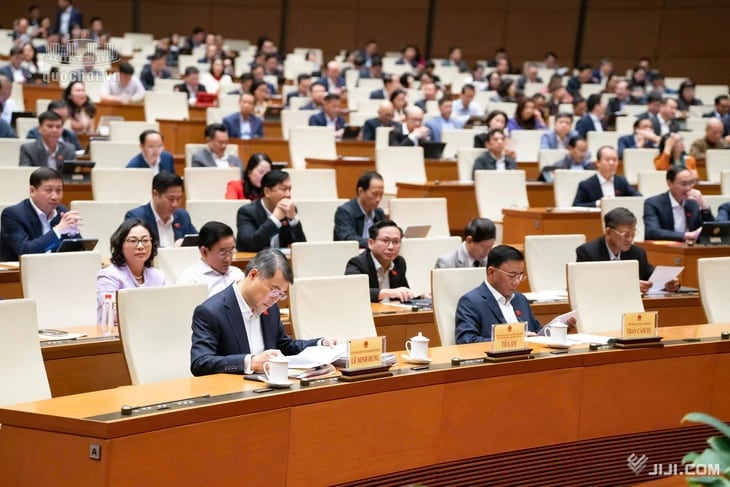
Newly established small and medium-sized enterprises (SMEs) will benefit from corporate income tax incentives, including an exemption during their initial period of operation, under a new law passed by Vietnam’s National Assembly on Friday.
The Law on the Development of Small and Medium-sized Enterprises defines SMEs as businesses with an average annual workforce of no more than 300 employees in the preceding year that meet at least one of two criteria: total capital of no more than VND150 billion (US$5.8 million) or annual revenue of no more than VND400 billion ($15.5 million).
Taking effect on July 1, 2027, the law introduces various support policies covering taxation, credit, production premises, science and technology, innovation, and market expansion.
Notably, tax incentives are designed for different groups of businesses, with priority given to micro and small enterprises, innovative startups, and businesses operating in high-tech and strategic technology sectors.
Under the law, micro and small enterprises will be subject to corporate income tax rates lower than the standard rates, in accordance with the law on corporate income tax.
Another provision allows businesses with annual revenue of no more than VND10 billion ($386,935), or a threshold adjusted by the government in certain periods, to choose the tax calculation method in accordance with the law on corporate income tax.
SMEs operating in high-tech and strategic technology sectors will be eligible for corporate income tax incentives under the laws on corporate income tax and high technology.
The law also expands accounting support. Micro enterprises will be allowed to apply simplified accounting rules and tax-related administrative procedures.
Innovative startups are another group eligible for notable incentives.
The law grants corporate income tax exemptions and reductions on income from innovative startup activities earned by innovative startup SMEs, innovative startup investment fund management companies, and intermediary organizations supporting innovative startups.
Land rental costs cut by at least 30% for first 5 years
Beyond tax incentives, the Law on the Development of Small and Medium-sized Enterprises includes various direct support policies to reduce businesses’ input costs and enable them to expand production and operations.
Under the law, SMEs will receive support equivalent to at least 30 percent of their land sublease payments for the first five years from the date they sign sublease contracts with infrastructure developers of industrial parks, industrial clusters or eligible business incubation facilities.
The support will be provided either through state reimbursements to the infrastructure developers or vouchers that SMEs can use to pay the subsidized portion of their land sublease costs.
The law also stipulates that infrastructure developers of industrial parks, industrial clusters and eligible business incubation facilities receiving investment support must reserve part of their developed land for lease or sublease to SMEs, giving priority to innovative startups and businesses in supporting industries.
In public procurement, construction packages, goods procurement packages and mixed goods-and-construction packages funded by the state budget, with a package value of no more than VND20 billion ($776,357), will be reserved for SMEs to participate in.
Government agencies and organizations must also allocate at least 20 percent of the total value of annual procurement packages funded by the state budget to SMEs, excluding packages subject to international bidding.
Thanh Ha – Tien Long – Thanh Chung / Tuoi Tre News