Washington courts more ASEAN nations for ‘Pax Silica’ AI pact


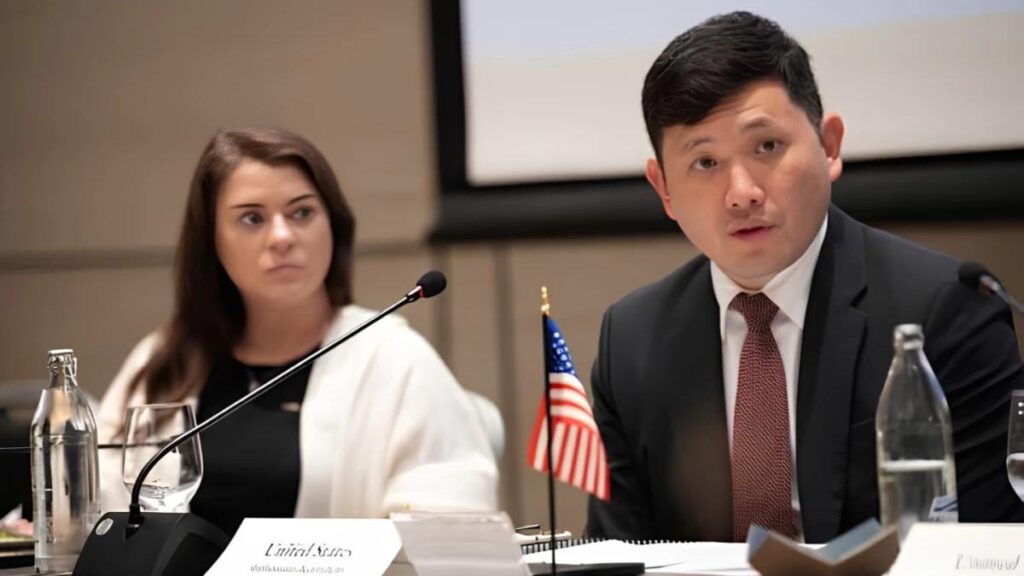
The United States (US) is open to including more member states of the Association of Southeast Asian Nations (ASEAN) in the Pax Silica initiative as it looks to strengthen its supply chains for the development of artificial intelligence (AI).
US Ambassador to ASEAN Kevin Kim said the Trump administration is always open to building as many partnerships as possible with countries around the world to bolster its supply chains, including those within ASEAN.
“This means that we’re willing to talk to anyone, anywhere, anytime in order to build mutually beneficial supply chain initiatives,” Kim said in a press briefing on Wednesday, Nov. 18.
Launched last year, the Pax Silica initiative was created by the US to bring allied countries together to secure the global AI supply chain and counter China’s dominance in the sector.
According to the US State Department, there are currently 25 signatories to the global cooperation, including ASEAN members the Philippines and Singapore.
Other ASEAN economies, such as Indonesia, Malaysia, Cambodia, Laos, and Myanmar, are members of the World AI Cooperation Organization (WAICO), a rival AI supply chain partnership led by China.
While Kim did not indicate any US efforts to encourage current WAICO members to join Pax Silica, he noted that cooperation with ASEAN on AI is an “absolute priority” for the Trump administration.
“Fundamentally, for the United States, we understand that the future [is the] digital economy, and Southeast Asia will be at the heart of that future,” he said.
In line with Pax Silica, the US is investing around $134 million in the SI SPARK program to provide foreign assistance for the acquisition of American AI technology in Southeast Asia.
Kim added that the US supports the newly signed Digital Economy Framework Agreement (DEFA), which aims to establish a regional framework for an interconnected digital marketplace within ASEAN.
Even so, he noted that the US remains an “unwavering supporter” of ASEAN centrality, meaning it respects the choices of every ASEAN member state in whatever partnerships they pursue.
“At the core of our interest is a strong ASEAN, a strong Southeast Asia that can shape and determine its own future based on its own values and its own interests,” Kim said.
US President Donald Trump made his state visit to Manila on Tuesday and Wednesday, where he announced that he had agreed to the “biggest trade deal ever made” between the Philippines and the US.
While details of the agreement have not yet been made public, Trump’s visit was clouded by protests across the country over fears that an impending deal for the proposed Pax Silica industrial hub in New Clark City would be signed.
Although President Ferdinand Marcos Jr. asserted that the landmark deal for the industrial hub was not signed during the state visit, criticism has remained widespread over environmental and displacement concerns surrounding the project.
Referred to as the Clark Advanced Manufacturing Park (CAMP), the industrial hub is part of the country’s commitment to Pax Silica, under which it will jointly develop the property with the US to attract investments in the advanced manufacturing sector.
The Bases Conversion and Development Authority (BCDA), the primary government agency overseeing CAMP, said the project is expected to contribute as much as $200 billion in export revenue to the country over 30 years of development.
The BCDA has likewise insisted that governance of the industrial hub will remain under Philippine law, pushing back against earlier assumptions that it would operate as a diplomatic property.