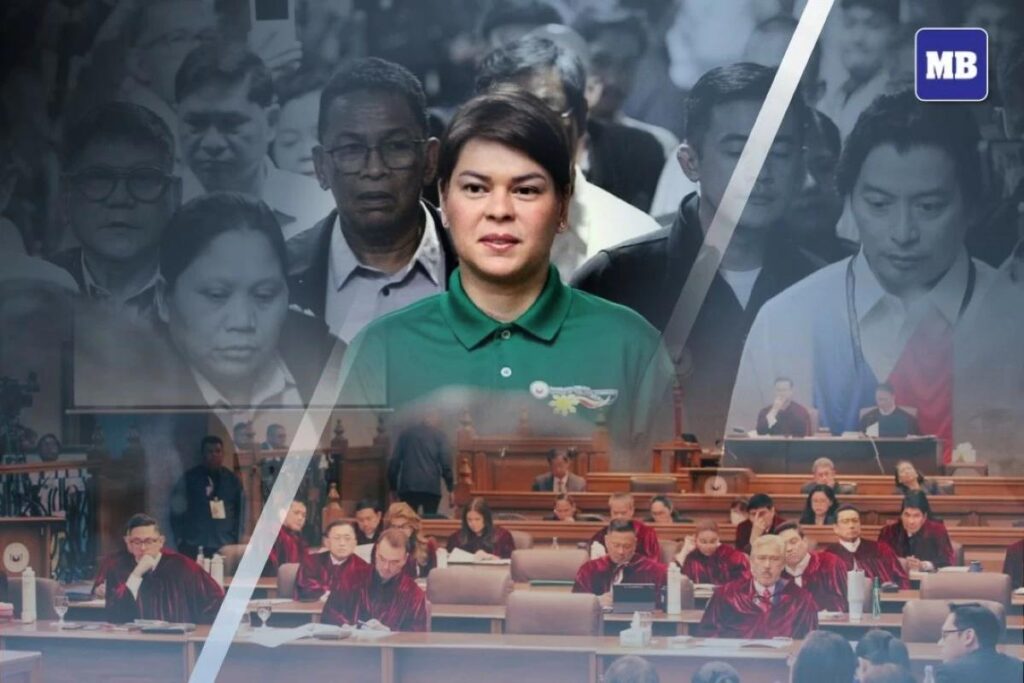
Vice President Sara Duterte’s defense team will begin presenting its evidence before the Senate impeachment court on Monday, Nov. 9, with dozens of witnesses lined up for the first week to counter allegations of unexplained wealth.
Ahead of the resumption of the impeachment trial, Duterte’s camp on Saturday, Nov. 7, slammed the House prosecution panel, accusing its members of spreading “half-truths and malicious speculation” through what it described as excessive press briefings and media interviews.
In a statement, Duterte’s spokesperson Atty. Salvador Paolo A. Panelo Jr. said the prosecution had failed to prove its case, stressing that allegations must be established through evidence presented in court.
“The prosecution had its chance. It failed,” Panelo said. “On Monday, the Vice President begins her defense,” he added.
Panelo also stressed that due process requires that an accused be given the opportunity to answer allegations before being condemned.
“We apparently live in two worlds. One where due process and fairness still reign—where an accused is not condemned before she is heard, and where allegations must be proven with clear and convincing evidence presented in court,” he said.
“One world seeks the truth. The other desperately tries to persuade an increasingly skeptical public with asinine sound bites built on half-truths and malicious speculation, spewed out in daily, obtrusive, and nauseating press briefings and interviews,” he added.
READ:
Defense to present 24 witnesses
The defense has lined up 24 witnesses from Nov. 9 to 13 to address Article II, the sole remaining charge against Duterte after the prosecution withdrew three other impeachment articles.
Article II accuses the vice president of accumulating wealth disproportionate to her lawful income, failing to fully disclose her assets and liabilities in her Statements of Assets, Liabilities and Net Worth (SALNs), and maintaining prohibited business interests while in public office.
Among the first witnesses expected to testify is Atty. Suzette Balucanag-Punay, corporate counsel of GenCorp Industries Inc. and Metro City Chow Foods Corp. She is expected to present corporate records, including general information sheets and audited financial statements covering 2022 to 2025.
The defense also plans to present Davao City Assessor Engr. Jaime Adalin and Island Garden City of Samal Assessor John Kenneth Enumerables to discuss tax declarations and tax maps involving properties cited by the prosecution.
Davao City accountant Vingelin Bajan is expected to present payroll records and vouchers concerning Duterte’s salary and compensation during her local government service.
Matina Crossing Barangay Chairperson Cindy Colina is also expected to testify on the barangay’s creation, official name, and other names by which it is known.
The defense has likewise listed representatives from eight banks to identify documents concerning requests for financial information made by Duterte and her husband, lawyer Manases Carpio, through their legal representatives.
Other witnesses include Atty. Anel Martin S. Antero, Chadrin S. Parian, and Quezon City Prosecutor Vimar M. Barcellano, who are expected to dispute allegations and factual assertions under Article II.
First defense witness withdraws
The defense’s original witness list included law professor Dean Ralph Sarmiento, who was scheduled to testify on Nov. 9 on legal and constitutional principles relevant to the impeachment case.
However, Sarmiento declined the invitation on Nov. 5, saying he wanted to preserve his independence as a constitutional law professor and legal analyst. The defense subsequently withdrew its request for the impeachment court to subpoena him.
Defense spokesperson Atty. Michael Poa said the team respected his decision.
“We respect Dean Sarmiento’s personal decision and appreciate his initial consideration of our invitation,” Poa said. “We wish him well in his continued contributions to constitutional discourse,” he added.
With Sarmiento’s withdrawal, Balucanag-Punay is expected to become the first defense witness.
Court admits prosecution’s evidence
In an order dated Nov. 5, the Senate impeachment court admitted documentary evidence submitted by the prosecution under Article II, subject to exclusions and limitations.
The admitted records include documents from the Anti-Money Laundering Council (AMLC), banks and financial institutions, Bureau of Internal Revenue (BIR), Securities and Exchange Commission (SEC), Land Registration Authority, Philippine Government Electronic Procurement System, Philippine National Police Firearms and Explosives Office, insurance and investment companies, and the Office of the Ombudsman.
However, the court excluded records concerning confidential fund disbursements by the Office of the Vice President and Department of Education in 2022 and 2023, including Commission on Audit findings and Notices of Disallowance.
The court ruled that evidence under withdrawn Article I could not be re-offered or indirectly raised under Article II.
It also excluded corporate records of JTC Group of Companies Philippines Inc. and Pikimong Pikimong Philippines Corp., as well as portions of the forensic report by prosecution witness and financial analyst Atty. Alexander Cabrera that relied on those records.
The court limited the use of financial records covering 2007 to 2021 to establishing a baseline for comparison with Duterte’s assets, liabilities, income, and business interests from 2022 to 2025. These records cannot be used to establish separate offenses before her current term.
With the resolution of the prosecution’s formal offer of evidence, the prosecution is deemed to have rested its case on Article II.
READ:
Defense challenges prosecution’s evidence
Before the court’s ruling, Duterte’s lawyers filed a 26-page comment on Oct. 30 asking the impeachment court to reject the prosecution’s formal offer of evidence.
The defense questioned the relevance, admissibility, and authentication of financial and corporate records, including Duterte’s SALNs, bank records, corporate filings, tax documents, and insurance records involving her and Carpio.
“These exhibits were not attached to the Impeachment Complaints that the respondent was made to answer. Neither do they form part of the Articles of Impeachment,” the defense said.
It described the House Committee on Justice’s evidence-gathering as an “impermissible fishing expedition,” accusing prosecutors of collecting documents in a “massive trawling fashion” to build their case.
The defense questioned financial disclosures covering periods before Duterte assumed the vice presidency on June 30, 2022, arguing that these could not independently establish impeachable acts during her term.
It challenged the bank records, saying prosecutors had not identified specific accounts allegedly used to receive, withdraw, transfer, or conceal funds in connection with Article II.
The defense also questioned the inclusion of AMLC records, citing confidentiality provisions under the Anti-Money Laundering Act, as amended by Republic Act No. 11521.
It further argued that the prosecution’s withdrawal of three of the four impeachment articles weakened its remaining case.
“Given the prosecution’s withdrawal of Articles 1, 3, and 4, the remaining article no longer has any leg to stand on,” the Oct. 30 comment read.
The withdrawn articles covered allegations of misuse of confidential funds, bribery, and grave threats.
Withdrawn charges
The defense’s objections to the withdrawal of three impeachment articles date back to the Oct. 13 proceedings, when Poa clarified during a post-trial press briefing that the team did not oppose the prosecution’s decision to withdraw the charges but questioned whether it could still present rebuttal evidence on allegations already raised in court.
“We are not given now the opportunity to present rebuttal evidence through the testimonies of our witnesses,” Poa said.
He said the defense wanted to present its own evidence rather than rely solely on statements made during media briefings.
“We wanted to be able to present evidence even on those articles that were withdrawn because gusto nating malaman ng ating mga kababayan ang buong katotohanan at hindi yung katotohanan patay sa isang panig lamang (we want our fellow Filipinos to know the whole truth, not just a one-sided version of it),” he said.
Poa cited the prosecution’s presentation of witnesses on confidential funds and grave threats before the corresponding articles were withdrawn. He also questioned the impeachment court’s earlier ruling relaxing the application of Rule 18, or the sub judice rule, on the withdrawn articles.
Lead defense counsel Atty. Sheila Sison likewise argued that the withdrawal should not prejudice Duterte’s right to answer allegations already presented during the trial.
“That prerogative to withdraw an accusation is not the power to suppress its rebuttal on the part of the respondent,” Sison said in her manifestation during the impeachment trial on Oct. 13.
“The authority to streamline, or to achieve speed in a trial, is not the authority to diminish due process, or to altogether disregard fundamental rules of fairness,” she said. “And the desire to reach a verdict expeditiously can never justify reaching it unfairly,” she added.
The Senate impeachment trial is scheduled to resume at 10 a.m. on Nov. 9, following a suspension to give way to Senate deliberations on the proposed 2027 national budget.
RELATED STORY: