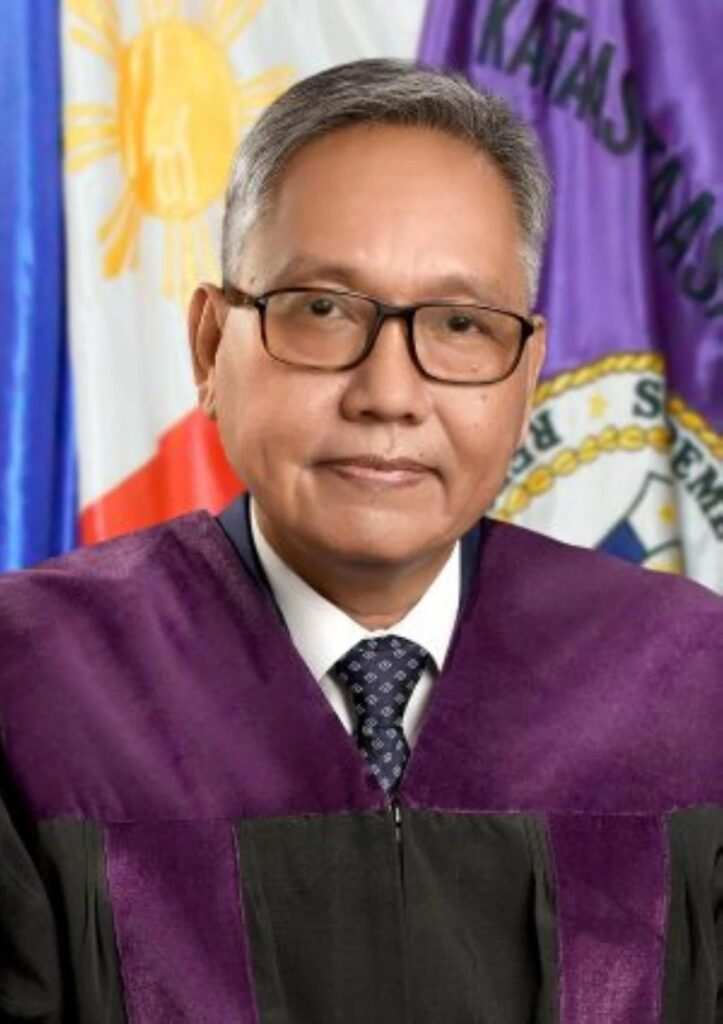
Chief Justice Rodil V. Zalameda has reminded judiciary members that court decisions affect people’s lives, whether immediate and visible or broader and less visible.
The Chief Justice said that the impact of court decisions are immediate and visible when a person regains liberty, a family recovers property, or a victim obtains redress.
In other times, he also said, the impact is broader and less visible like when a decision clarifies constitutional principles or strengthens public confidence in the rule of law.
The Chief Justice pointed out that while previous court decisions provide guidance, “justice also requires an appreciation of the realities in which legal rules operate and the consequences that judicial decisions inevitably produce.”
However, he clarified that judges and justices may not substitute their own views for the requirements of the Constitution or the law.
“The delivery of justice requires both fidelity to principle and sensitivity to consequence. We must remain faithful to the Constitution and statutes, respectful of precedent, and conscious of the limits of judicial power,” he stressed.
He pointed out the importance of prudence and discernment in the exercise of judicial power as he reminded members of the Judiciary that their decisions carry consequences that extend beyond the courtroom.
Chief Justice Zalameda’s declarations were contained in his message during the conferment of the degree of Doctor of Laws (honoris causa) by his alma mater, the University of the East (UE) last Oct. 27.
He was conferred the honorary degree when he was still an associate justice of the Supreme Court (SC). He was appointed Chief Justice last Nov. 5 and assumed the top post in the judiciary on Nov. 6, the date of the retirement of then Chief Justice Alexander G. Gesmundo.
In his message he also said: “This is why the judicial office demands restraint, independence, humility, and above all, a constant awareness that the authority to decide carries with it the responsibility to decide carefully.”
“The delivery of justice requires both fidelity to principle and sensitivity to consequence. We must remain faithful to the Constitution and statutes, respectful of precedent, and conscious of the limits of judicial power,” he added.
He also said: “As members of the Judiciary, we are entrusted with power that does not belong to us personally. The authority of the courts comes from the Constitution and the law. It is exercised not for the benefit of those who wear the robe, but for the benefit of the ordinary Juan and Juana dela Cruz who come to the courts seeking justice.”
In conferring the honorary degree, UE cited Chief Justice Zalameda for his “distinguished service as a jurist and public servant, and the honor and distinction he has brought to the university and the nation.”
UE Caloocan Chancellor Victor R. Macam Jr. emphasized that the impact of Chief Justice Zalameda’s public service lies not in the distinction of the positions he held, but in the contributions he made as an SC associate justice that helped shape and strengthen the rules and institutions governing the administration of justice.
Among these contributions cited by Macam were Zalameda’s leadership of the Sub-Committee on the Revision of the Rules of Criminal Procedure, the Sub-Committee on Special Rules on Extradition, the Committee on Security, and the Technical Working Group that drafted the Implementing Rules and Regulations of the Judiciary Marshals Act.
He also said that Zalameda also served as vice-chairperson of several committees, namely the Sub-Committees for the Revision of the Rules on Special Proceedings and on the Admissions to the Bar, the Committees for Sustainability and Environmental Concerns, as well as the Technical Working Groups for the Drafting of the Rules on Unified Legal Aid Service and the Creation of a Governance Framework for the Use of Artificial Intelligence in the Judiciary.
“These responsibilities reflect not only the breadth and depth of his legal experience, but also his continuing contribution to the development of a more responsive, accessible, and modern Philippine Judiciary,” Chancellor Macam added.