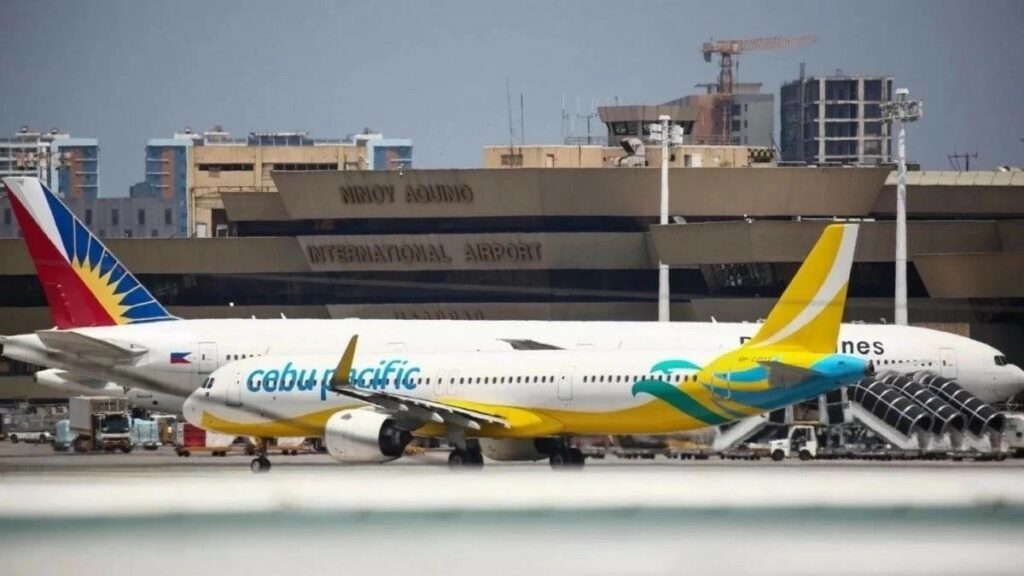
Airfares will be slightly lower in the second half of November after the government adjusted the passenger fuel surcharge down a notch in response to easing jet fuel prices.
In its latest advisory, the Civil Aeronautics Board (CAB) said fuel surcharge, which is imposed by airlines on local and international flights, will drop to Level 16 for Nov. 16 to 30 from the current Level 17.
At Level 16, carriers may levy a minimum surcharge of ₱525 for short-distance local flights and up to ₱1,535 for longer routes, such as Manila to General Santos City.
For travelers flying abroad, surcharge ranges from a low of ₱1,733.76 to as much as ₱12,891.29, depending on distance.
Based on CAB’s matrix, flights to regional spots like Thailand and Singapore would have additional surcharge of ₱2,397.82, while destinations such as Japan and South Korea will carry a higher surcharge of ₱2,697.07.
Traveling to the Middle East and Australia will cost passengers an additional ₱5,965.68, and further up to ₱12,277.42 for flights to the United States (US), Canada, and the United Kingdom (UK).
CAB said airlines wishing to impose and collect fuel surcharge for the second half of November must file their respective applications before Nov. 16.
For surcharges to be collected in foreign currencies, the regulator set the exchange rate at ₱63.61 to $1.
Fuel surcharge is not part of basic airfare and may be collected by airlines to help them recover losses stemming from surging jet fuel prices, according to CAB.
According to the International Air Transport Association (IATA), the average price of jet fuel in the global market declined by seven percent on an annual basis to $178.95 per barrel as of Nov. 6.
Within Asia and Oceania, jet fuel prices declined further by 7.5 percent to an average of $163.25 per barrel, the lowest price level across all regions.
Jet fuel price continues to be volatile amid ongoing tensions in the Middle East that continue to test the commodity’s supply.
For local airlines, elevated jet fuel prices have largely dragged down their financial performance even as passenger demand remained relatively stable.
Gokongwei-led budget carrier Cebu Pacific reported that its net loss widened to nearly ₱13 billion in the nine months through September, while Lucio Tan-led flag carrier Philippine Airlines (PAL) swung to a net loss of ₱9.74 billion.