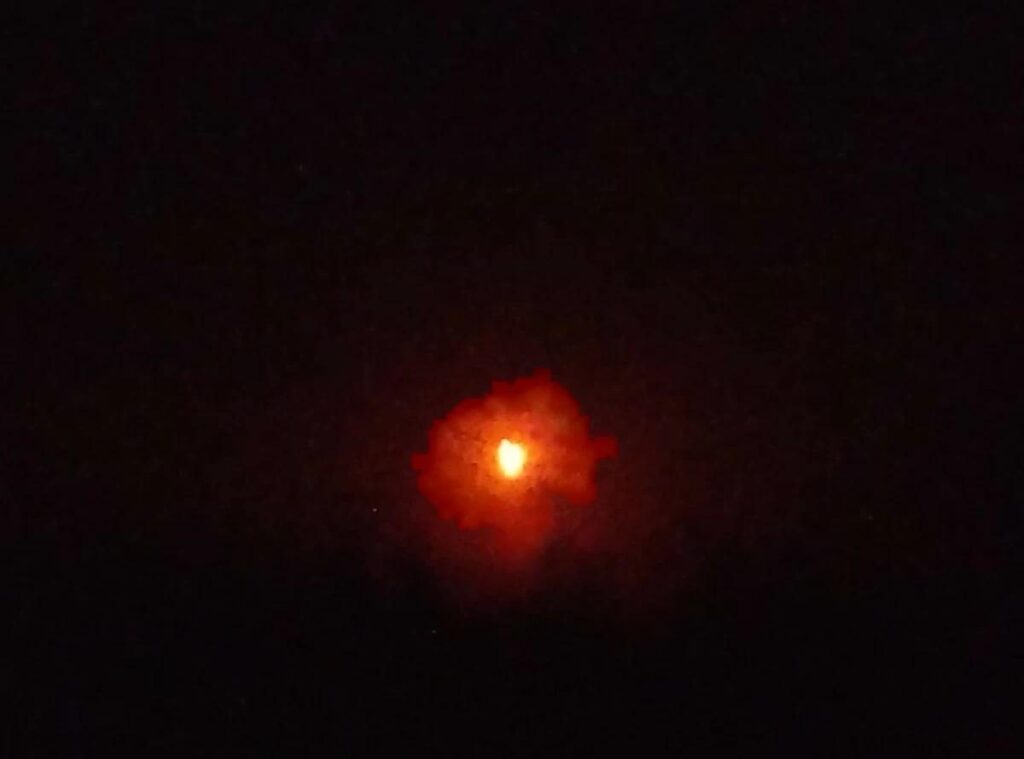
Unusual luminous trails and loud sounds were observed over parts of Palawan and several Philippine-held outposts in the West Philippine Sea (WPS) on Monday, Nov. 9, following the launch of a Chinese rocket from Hainan, prompting the Philippine Navy (PN) to place its units on heightened readiness.
The Naval Command West (NAVCOMWES) said China’s Long March-12 rocket lifted off from the Hainan International Commercial Launch Center in Wenchang, Hainan at about 4:24 a.m. Philippine time on Monday.
The command closely monitored the launch and coordinated with government agencies as well as sailors and marines stationed in the Kalayaan Island Group (KIG) to assess its effects and ensure the safety of communities within its area of operations.
The NAVCOMWES said its personnel in Puerto Princesa City reported seeing a bright cone-shaped vapor trail moving from northwest to southeast around 4:33 a.m.
“Initial assessments based on available open-source information indicate that the observed ‘space jellyfish’ phenomenon was likely caused by the expansion of rocket exhaust gases at high altitude, illuminated by sunlight while observers on the ground remained in darkness,” said Rear Adm. Vincent Sibala, commander of NAVCOMWES.
“Such visual effects are commonly associated with rocket launches conducted during pre-dawn or twilight conditions,” he added.
About four minutes later, NAVCOMWES observers reported hearing a loud explosive sound followed by two lower-intensity sounds and rumbling that authorities assessed could have been linked to the rocket’s ascent and atmospheric flight profile.
Similar observations were reported across several Philippine stations in the WPS, the Navy said.
Personnel at Lawak and Patag stations saw white luminous trails about 60 to 70 nautical miles east of their locations.
Likas Station reported a faint white light about 100 nautical miles northeast of the outpost while Rizal Reef Station personnel also observed a white luminous trail about 80 nautical miles east-southeast of the station before it disappeared from view.
Meanwhile, personnel at Tubbataha Station reported seeing a bright luminous object about 19 nautical miles from their position.
The Navy said that initial assessments indicated the visual phenomenon was likely caused by rocket exhaust gases expanding at high altitude and illuminated by sunlight while areas below remained in darkness.
Such sightings are commonly associated with rocket launches during pre-dawn or twilight conditions, it explained.
As a precaution, all PN units and assets under the command were placed on heightened alert status to facilitate immediate reporting and assessment of any incident within its area of responsibility.
The NAVCOMWES said it has maintained coordination with partner agencies, coastal communities, and fisherfolk to ensure prompt reporting of suspected rocket debris, falling objects, or other related maritime and aerial incidents.
New Navy second in command
On the same day of the sighting, the PN installed Rear Adm. Juario C. Marayag as its new Vice Commander during a ceremony presided over by Vice Adm. Jose Ma. Ambrosio Q. Ezpeleta, Flag Officer in Command .
Marayag, who succeeded Rear Adm. Edwin Nera, linked the service’s future tasks to the changing security landscape at sea.
“As I begin my tour of duty, our Navy will continue to grow. Our evolving maritime security environment, the modernization of our force, and the responsibilities entrusted to us require unity, discipline in execution, and commitment,” Marayag said.
The PN said his appointment supports leadership continuity and sustained mission readiness as it seeks to strengthen its capabilities in protecting the country’s maritime interests.