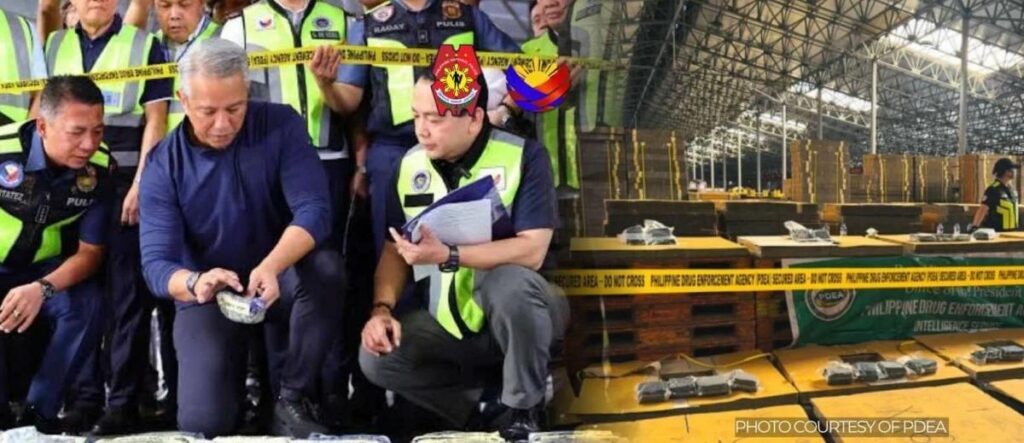
Authorities have stepped up monitoring and intelligence-sharing with neighboring countries following the confiscation of around 200 kilos of shabu at the Manila International Container Port (MICP), a top Cabinet official said.
Department of the Interior and Local Government (DILG) Secretary Jonvic Remulla said the move is intended to prevent the entry of illegal drugs after the two strategies that drug syndicates had attempted to smuggle shabu was busted.
The first was the supposed transportation of around P3.5 billion worth of shabu that was seized in Laos while the recent was the P1.3 billion worth of shabu seized at the MICP.
“Well, they are having a hard time at sea because we intercepted about 17 tons on the open sea so now they are trying to go through other routes,” said Remulla.
“So from now on, we’re going to flag all shipments coming from Laos—we’ll check if there are actually drugs involved, since they (drug syndicates) tend to hide them when sending items here.”
“As for the one from yesterday—that was the first time I’ve ever seen something like that, hidden inside the cardboard—but it also came from Laos,” he added.
For his part, Philippine National Police (PNP) chief Gen. Jose Melencio C. Nartatez, Jr. said a thorough investigation is now being conducted to determine possible links between international drug trafficking operations in the country following the two shabu confiscations.
“Our priority is to identify those behind these operations, disrupt their supply routes, and ensure that the Philippines will never become a safe passage for international drug syndicates,” Nartatez said.
Around 200 kilograms of suspected methamphetamine hydrochloride were intercepted from a 40-foot shipping container by operatives from the Philippine Drug Enforcement Agency, Bureau of Customs, and PNP, it was reported on Wednesday, Nov. 4.
The illegal drugs were concealed in four packs placed among about 50 boxes declared as cardboard. The shipment originated from Laos and passed through Haiphong, Vietnam, and Hong Kong before reaching Manila.
The PNP is also investigating the consignee as authorities work to determine whether the shipment was part of a wider international drug trafficking operation.
Nartatez said the PNP is strengthening surveillance and intelligence-sharing with domestic and foreign law enforcement counterparts to detect and intercept shipments being moved through international trade routes.
“We are examining these major seizures beyond their individual circumstances to determine whether they point to a common drug trafficking network operating across borders,” he stated.