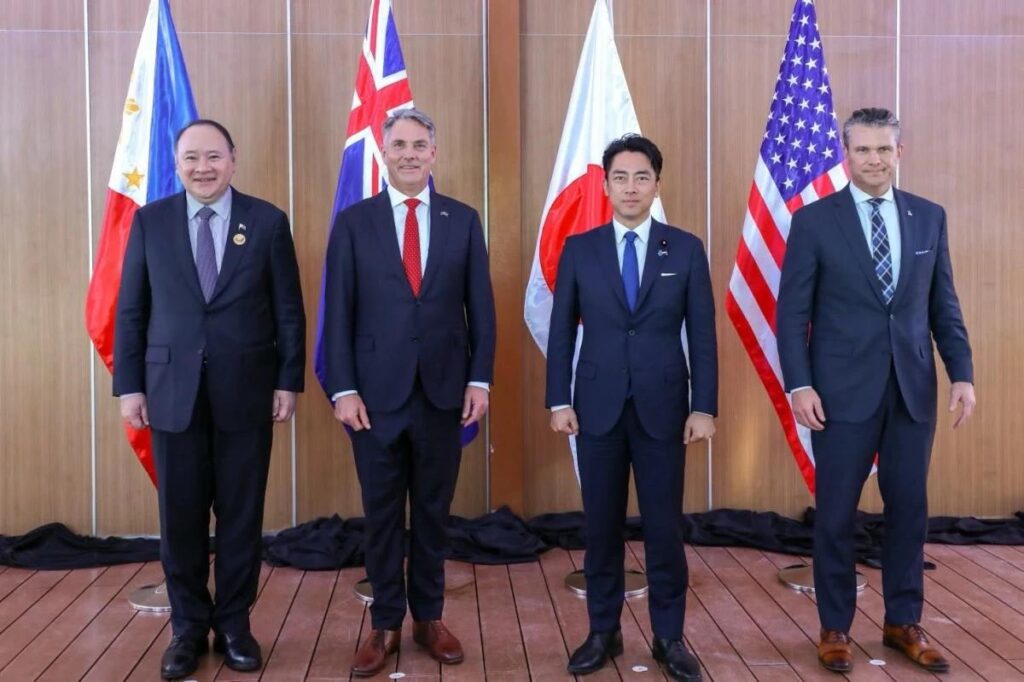
The Department of National Defense (DND) revealed that it will establish a joint coordination hub in the country with three of its key defense partners – the United States, Japan, and Australia or collectively known as the “Squad” – as they seek to tighten military cooperation and strengthen their ability to respond to security challenges in the Indo-Pacific.
The proposed Combined Coordination Center (CCC) was among the “forward-looking initiatives” discussed by DND Secretary Gilberto Teodoro Jr. when he met with US Secretary of War Pete Hegseth, Japanese Defense Minister Koizumi Shinjiro, and Australian Deputy Prime Minister and Defense Minister Richard Marles in Cebu on the sidelines of the ASEAN Defense Ministers’ Meeting-Plus (ADMM-Plus), which the Philippines hosted, on Oct. 28, according to a joint statement released by the DND on Tuesday, Nov. 10.
According to the DND, the Squad leaders committed to establishing the coordination center in the Philippines, synchronizing defense investments to support the country in defending its archipelago, strengthening ministerial and senior policy-level consultations, and expanding the scope, complexity, and frequency of their combined military exercises and cooperative activities.
The DND did not provide further details on the proposed center’s location, organizational structure, timeline for establishment, or the specific functions it would perform.
However, it said the proposed hub would mark another step in the growing defense alignment among the four countries, which have intensified joint military engagements amid rising security concerns in the region.
The proposed center would build on the existing Defense Cooperation Council (DCC), a four-country military cooperation framework formalized through the signing of its Terms of Reference in Singapore last May 29.
Signed by the military chiefs of the Philippines, Australia, Japan, and the United States, the framework provides for information sharing, regular multilateral maritime activities, coordinated strategic communications, and improved interoperability in operational planning, logistics, and military sustainment.
The four defense chiefs also reiterated their serious concerns over developments in the East China Sea and the South China Sea and reaffirmed their “strong opposition to any unilateral actions, including by force or coercion, which escalate tensions and undermine regional peace and stability.”
China has increasingly asserted its activities in disputed waters, particularly its expansive maritime claims and actions involving Philippine vessels in the West Philippine Sea.
Beijing’s claims overlap with the Philippines’ exclusive economic zone and have repeatedly put it at odds with Manila over maritime rights and access to resources.
China has also rejected the 2016 arbitral ruling that invalidated the legal basis of its expansive claims in the South China Sea.
As such, Manila has increasingly expanded its defense engagements with like-minded countries as it works to improve its military capabilities and protect its maritime interests.