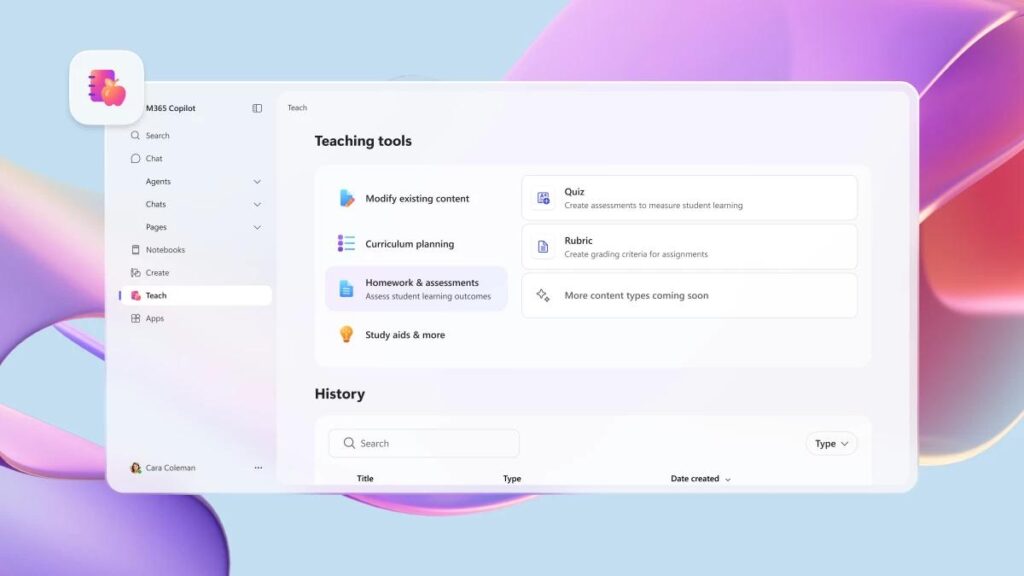
The classroom of the future is often imagined as a room filled with robots, holograms, and intelligent machines. In reality, it has arrived more quietly. It is present whenever a student asks an artificial intelligence assistant to explain a difficult lesson, whenever software adjusts an exercise according to a learner’s performance, or whenever a class enters a virtual laboratory that the school could not physically build.
The transformation is already happening. The more difficult question is whether education systems are prepared for it.
Artificial intelligence can generate essays, answer questions, solve equations, create images, translate languages, summarize books, and write computer code. These capabilities challenge long-standing assumptions about teaching and assessment. If a machine can produce an acceptable answer within seconds, schools must reconsider what students should learn, how they should demonstrate learning, and which abilities must remain distinctly their own.
The Rise of the AI Tutor
One of the most closely watched applications is the AI tutor. Unlike a printed textbook or recorded lecture, an AI tutor can respond to questions, offer another explanation, generate practice exercises, and adjust its language to the learner’s level.
Used properly, it can provide support beyond classroom hours. A student who is reluctant to raise a hand can ask the same question repeatedly without embarrassment. A learner struggling with fractions can request a simpler example, while another who has mastered the lesson can move to a more demanding problem.
Early research offers reasons for cautious interest. A randomized study involving 900 tutors and 1,800 students found that learners whose tutors used the Tutor CoPilot AI support system were four percentage points more likely to master their topics. Students assisted by lower-rated tutors recorded greater gains. Importantly, the AI did not replace the tutor. It helped the human tutor use better strategies, including asking guiding questions rather than simply giving away answers.
That model offers a useful direction for schools. The strongest application of AI may not be an automated teacher at the front of the classroom. It may be a tool that helps teachers notice misconceptions, prepare appropriate interventions, and provide more individualized attention.
AI tutors nevertheless carry limitations. They can invent facts, misunderstand a question, provide explanations that are inappropriate for a learner’s age, or produce confident answers based on flawed information. Children may also mistake fluency for authority. Every tutoring system therefore needs reliable content, age-appropriate safeguards, transparent data practices, and meaningful teacher supervision.
Learning That Adjusts to the Student
Adaptive-learning systems use student performance to change the sequence, difficulty, or presentation of lessons. When a learner repeatedly struggles with a concept, the platform can provide additional exercises. When the learner demonstrates mastery, it can introduce more advanced material.
This approach can help teachers manage classrooms with widely different student needs. Rather than giving every child an identical worksheet, a teacher can review data showing who needs remediation and who is ready to proceed.
But personalization should not become isolation. Education is also a social process. Students learn by discussing ideas, listening to other perspectives, resolving disagreements, cooperating on projects, and explaining their reasoning. A system that keeps every child focused on an individualized screen may improve efficiency while reducing opportunities to learn with others.
Algorithms can also misjudge students. If a platform repeatedly gives a learner easier material because of earlier mistakes, it may quietly lower expectations. Teachers must remain able to examine, question, and override automated recommendations.
Laboratories Without Walls
Virtual laboratories can expand access to scientific experiences that would otherwise require costly equipment, chemicals, or specialized facilities. Students can simulate experiments, observe processes that happen too quickly or too slowly for an ordinary class, and repeat procedures without consuming materials.
A virtual environment can allow learners to explore the human body, assemble an electrical circuit, manipulate molecules, examine planetary motion, or rehearse a dangerous procedure before entering a physical laboratory.
These tools are particularly relevant in schools with limited laboratory resources. However, simulation should complement, not replace, physical investigation. Science also requires students to handle materials, measure imperfect results, recognize experimental error, follow safety procedures, and discover that real objects do not always behave like flawless digital models.
Smart Classrooms and Digital Textbooks
The smart classroom connects displays, student devices, learning platforms, sensors, and assessment tools. Teachers can present multimedia lessons, collect responses instantly, conduct remote sessions, and review patterns in student performance.
Digital textbooks can include animation, audio, interactive diagrams, adjustable text, translation, search, and accessibility features. Content can be updated more quickly than a printed edition. For students with visual, hearing, reading, or mobility-related needs, well-designed digital materials can offer options that a conventional book cannot.
The benefits depend on conditions outside the software. Devices require maintenance. Connections must remain stable. Teachers need training and technical support. Schools must protect student accounts and personal information. When access depends on expensive hardware or continuous internet service, digital education can deepen existing inequality instead of reducing it.
The Philippines cannot design the classroom of the future only for schools with fast broadband, new computers, and dedicated technical staff. Systems must also work in communities with shared devices, intermittent connectivity, limited electricity, and teachers already carrying heavy workloads.
Privacy Inside the Classroom
Educational technology can collect names, ages, school records, performance data, behavioral patterns, voice recordings, written work, and information about how children use a platform. AI tools may process this data on external servers or use interactions to improve their systems.
Schools must know what information is collected, where it is stored, who can access it, how long it is retained, and whether it is used for advertising or model training. Children cannot be treated as ordinary technology customers. Their age, vulnerability, and limited ability to understand long privacy policies require stronger safeguards.
UNICEF’s policy guidance on AI and children emphasizes safety, privacy, fairness, transparency, inclusion, and support for children’s development. UNESCO has likewise called for a human-centered approach to generative AI in education, including data protection, age-appropriate use, and validation of systems before large-scale adoption.
These are operational requirements, not abstract principles. A school should not upload student records, disciplinary reports, medical information, or identifiable children’s work into a public AI service without a lawful basis, clear safeguards, and an understanding of how the provider handles the data.
Rethinking Assessment
Generative AI has exposed a weakness in assignments that reward only the final answer. A student can ask a machine to produce an essay, solve a problem, or summarize a reading. AI-detection software cannot provide a reliable solution because generated and human writing can be difficult to distinguish, and innocent students may be falsely accused.
Assessment must increasingly examine the learning process. Teachers can require students to explain their reasoning, defend their conclusions, document sources, revise work after feedback, conduct interviews, perform demonstrations, and connect lessons to local problems.
Oral examinations, supervised writing, portfolios, experiments, collaborative projects, and reflective journals can provide evidence of what students understand. When AI is permitted, learners can be required to disclose how they used it, verify its output, identify errors, and explain which decisions remained their own.
The purpose is not to make every assignment resistant to technology. It is to design work in which outsourcing the entire task would also surrender the learning.
What Should Students Learn?
Foundational knowledge remains essential. Students cannot evaluate an AI-generated answer if they lack enough understanding to recognize an error. Reading, writing, mathematics, science, history, and civic education provide the knowledge against which students must test automated output.
AI literacy must be added to those foundations. Students should understand that generative systems predict outputs from patterns in data. They should know that these systems can fabricate information, reproduce bias, omit context, and present uncertain claims with confidence.
They must learn how to formulate good questions, compare sources, inspect evidence, protect personal data, recognize manipulation, and decide when an AI tool should not be used.
Schools should also value abilities that cannot be reduced to generating an answer: judgment, curiosity, empathy, communication, creativity, collaboration, ethical reasoning, and the capacity to define a problem before attempting to solve it.
A machine can propose several answers. The student must still decide whether the question is worth asking, whether the evidence is reliable, who it may affect, and what responsible action should follow.
Teachers Remain at the Center
AI does not make teachers less important. It increases the importance of their judgment.
Teachers understand the child behind the test score. They recognize fear, confusion, effort, conflict, and potential. They create a classroom culture, protect students, resolve misunderstandings, and connect knowledge with values and lived experience.
Technology can help prepare lessons, translate materials, generate examples, or identify patterns. It cannot assume responsibility for a child’s education.
The classroom of the future should therefore not be defined by the number of screens, sensors, or AI subscriptions it contains. It should be judged by whether technology helps teachers teach, helps students think, expands access, protects children, and strengthens genuine learning.
Machines can already generate answers. Education’s enduring task is to develop people who can question those answers, test them against evidence, use them responsibly, and create something better.